The core contradiction of Europe’s energy problem is simple: demand is large, but underground resources are limited. This is not a short-term policy failure or a temporary market fluctuation. It is closer to a geological destiny. Compared with regions such as the Persian Gulf or western Siberia, Europe simply does not possess the large petroleum basins capable of sustaining a modern economy for long.
Oil and gas are never distributed evenly across the planet. The world’s largest reserves are concentrated in only a few regions, notably the Persian Gulf and the West Siberian Basin. These areas were once covered by vast and stable shallow seas. Over millions of years, enormous quantities of microscopic marine life accumulated on the seabed, forming thick layers of organic-rich rock. As these layers were buried and heated, they transformed into hydrocarbons. Crucially, geological structures formed huge traps that allowed oil and gas to accumulate into giant fields.
Europe’s geological history followed a different path. Much of the continent sits on very old continental crust. Sedimentary basins tend to be smaller, and the region has experienced multiple episodes of tectonic deformation over geological time. These movements often fragmented potential reservoirs into smaller pockets. In other words, Europe is not devoid of hydrocarbons, but it rarely forms the giant fields that define major petroleum provinces.
The North Sea is the main exception. Formed during the opening of the Atlantic Ocean, this rift basin accumulated organic-rich sediments and developed good sandstone reservoirs. This allowed the United Kingdom and Norway to become major oil producers during the late twentieth century. Yet even the North Sea fields are much smaller than the giant fields of the Middle East, and most lie offshore, making extraction more expensive.
More importantly, the North Sea is now a mature basin. British production peaked in the early 2000s and has declined steadily since. Norway still maintains significant output, but new discoveries are generally smaller. Even if Norway is considered part of Europe’s broader energy system, total European oil production remains far below its consumption.
Natural gas offers a slightly stronger position, but the structural limits remain. The Groningen field in the Netherlands was once one of Europe’s largest gas sources, yet production has been phased out due to earthquake risks. Newer fields in the Norwegian Sea and the Barents Sea exist, but their scale cannot replace Europe’s import needs. Even after the reduction of Russian pipeline gas, Europe continues to rely heavily on imported liquefied natural gas.
This structural gap leads to a straightforward conclusion. Europe cannot achieve energy self-sufficiency simply by expanding fossil fuel extraction. Even if every potential basin were redeveloped, the most likely outcome would be a modest reduction in imports rather than a fundamental change in the balance.
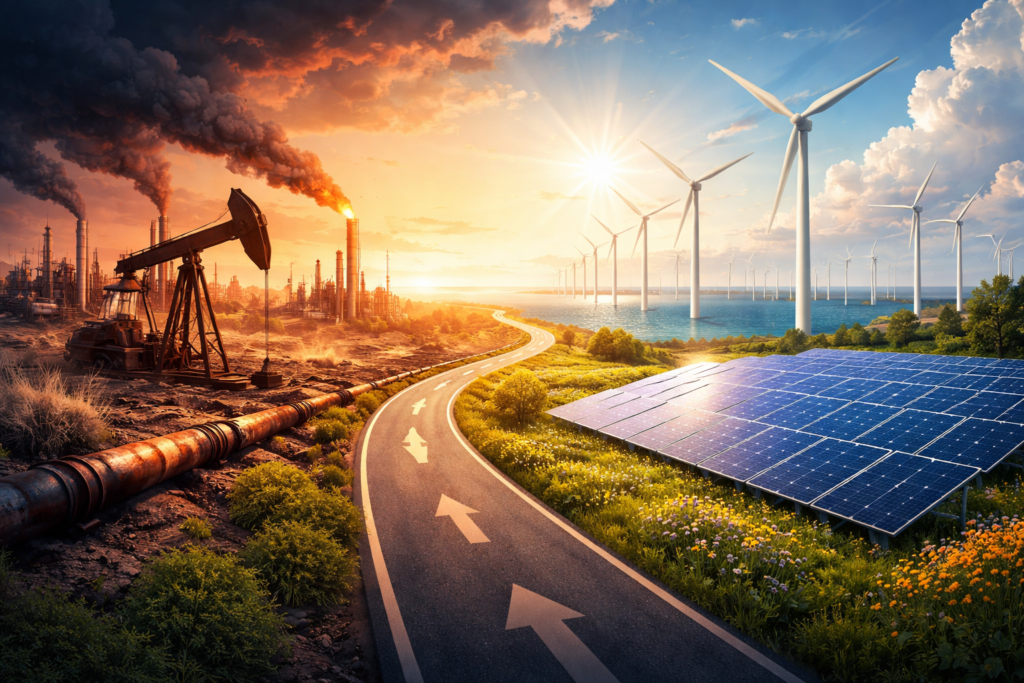
That reality explains why Europe has invested heavily in wind and solar power in recent years, while retaining nuclear energy and exploring geothermal resources. Unlike oil and gas, these energy sources are far more evenly distributed. They allow countries to generate energy locally rather than relying on a handful of resource-rich regions.
Seen from this perspective, Europe’s energy transition is not only a climate policy but also a pragmatic response to geological constraints. When the limits of underground resources are already set by nature, the only variable left to change is the structure of the energy system itself. For Europe, reducing dependence on fossil fuels is the only way to escape this energy destiny.